Additive mfg (3D Printing) technologies are evolving so rapidly that one needs to stay on its toes to follow all new leads. Many researchers are focused on developing new technologies while others working tirelessly to improvise the existing ones. Follow my blog if you want to witness the unfolding of next industrial revolution.
In the laser laser-based wirefeed systems, such as Laser Metal Deposition-wire (LMD-w):
Metal wire is fed through a nozzle.
Wire is melted by a laser using inert gas shielding in either an open environment (gas surrounding the laser), or in a sealed chamber.
Molten metal is deposited in a shape specified by the CNC control.
Applications
Large sized metal parts in Marine, Aerospace, Energy and Defense industries.
The process can serve as an alternative to Casting.
6ftx20in stainless steel propeller blade weighing 170lbs. The blade features a hollow interior with .25in sidewall and is made with little porosity or impurities due to closed loop senor system developed by MWES.
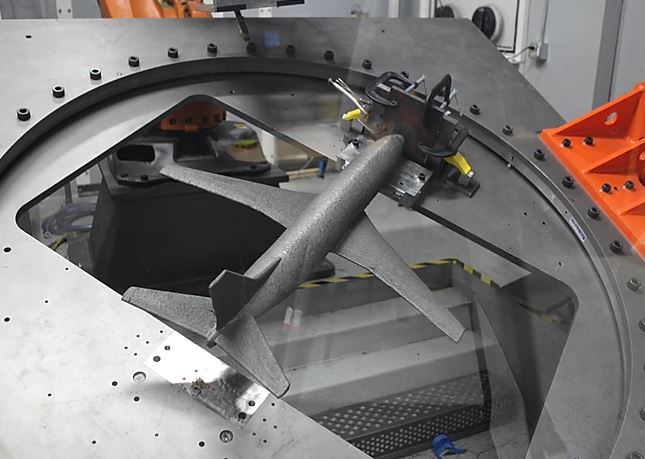
Fully stainless steel airplane. Weighing in at approximately 100 lbs. and 48in long, the plane body was made in Stainless Steel while the wings and tails in super duplex stainless steel. Total project printing time was 20 hours.
Print your customized circuit boards on the go with Nano Dimension's DragonFly LDM printer.
The machine uses the ink-jet deposition method of 3D printing.
With the ability to print traces and spaces down to an accuracy of one micron, the DragonFly™ inkjet deposition system is setting new accuracy and precision standards for 3D printed electronics. This allows the DragonFly™ to deliver in industries with the most demanding design and quality requirements, such as aerospace, telecom, healthcare and more.
Key Features:
Precise inkjet deposition system.
Multi-material 3D printing.
Optimized 3D Software - Switch.
Virtually limitless design flexibility.
The cost per board comes down to as low as $10.
Scenarios:
Innovating freely without traditional manufacturing process constraints.
Printing individual sections of your PCB design for on-the-fly testing.
Creating vias and through holes no drilling nor plating required.
Printing entire PCB products in-house in a matter of hours.
Saving space, weight and cost with designs incorporating complex geometries and new functions.
In this process objects are created by a 3D printer that uses a digital light projector (DLP) as the light source for curing photo-reactive polymers.
Simplified
Advantage over Stereolithography (SLA)
DLP is generally considered to be faster than SLA, and here’s why:
With SLA, the laser has to individually cure the resin in a “point to point” technique. On the other hand, a DLP projector screen flashes an image of a layer all at once! Thus all points of a layer can be cured simultaneously. In this way, the print speed is increased in comparison to SLA since it takes less time to cure a single layer.
XYZ 3D Printers
A Taiwanese 3D printers company launches a new DLP printer PartPro 120 xP
Connected to my previous Blog, today we are looking at few Additive Carbon-Fiber applications from the Industry.
Carbon Composite Tooling
Dash-CAE an English auto parts manufacturing company, making use of Fortus450mc and Fortus900mc machines to manufacture Tooling, Jigs and Fixtures for Rapid Prototyping and Composite services.
Finished Composite Automotive parts
Ducting for Supersonic Cars
Graphite AM another British engineering service bureau and consultancy firm has confirmed that it is an official 3D printing partner of the Bloodhound LSR supersonic car project. Applying its SLS expertise, the company is supporting the team’s ambitious goal of breaking the land speed record by supplying lightweight and high strength parts for the vehicle.
Carbon Composite Connector Rods
An Athens Greece based Machine Shop Extreme Tuners has created 3D printed carbon composite connector rods for the Mitsubishi Lancer Evolution car.
These Rods according to the company:
Weighs 10 times less than steel rods
Weighs 6.5 times less than Aluminum rods
Can withstand 3000 HP and approximately 15000 RPM
References: Dash-CAE Graphite AM Bloodhound LSR eXtream Tunners Stratasys
Light weight. 70% lighter than steel and 40% lighter than Aluminum.
Highly Strong and Stiff.
Heat resistant.
Posses very low coefficient of thermal expansion.
Highly corrosion resistant.
Resistant to chemicals.
Conductor of heat and electricity.
Challenge in Additive Manufacturing of Carbon fiber Parts
Because of very high melting temperature (around 3600 C) of the Carbon Fiber material, generally used mass manufacturing methods like Injection molding, Blow molding and Die-casting can not be used for Carbon fiber products. The same applies in Additive manufacturing as well. Currently used technologies in additive manufacturing are not capable of handling materials with such a high melting temperature. We can not process carbon fiber the conventional way (Extrusion or Binding and sintering).
Additive Solutions for Carbon Fiber Parts
Composite Parts by ExOne Washout Tooling
ExOne can print on-demand composite parts by their 3D Printed washout tooling.
3D printed soluble support materials are designed to create hollow
tooling and composite parts with trapped geometries. You can order parts
on demand developed with washout tooling for aircraft ducting, pressure
tanks, mandrels and more.
Currently, ExOne only offers printed and coated cores. Composite layup,
curing and washout is completed by our customers using filament winding
or application of prepreg woven fabric. Common layup materials that can
be applied to our cores are: carbon fiber, fiberglass, aramid fiber or
ceramic matrix composites (CMC).
Printing is performed with one of the thermoplastic material by FDM method. During the printing layers of FIBER are laid in certain area of the print to improve tensile strength.
Desktop Metal AFP machines
The company revealed Fiber HT and Fiber LT machines recently. The world’s first desktop 3D printer to fabricate high resolution parts
with industrial grade continuous fiber composite materials used in
automated fiber placement (AFP) processes. Based on a new process called
micro automated fiber placement (μAFP), users can now print parts with a
superior level of strength and stiffness, and in a broad range of
materials, that traditionally required million dollar AFP systems. More can be red about the release here.
Advancement by Anisoprint
Anisoprint CCF (Composite Carbon Fiber) and CBF (Composite
Basalt Fiber) are a composite reinforcing fibers in the form of a tow made of thousands of
ultrathin carbon or basalt monofilaments, impregnated with a special polymer composition
ensuring high-quality adhesion between the polymers and the fiber. Composite fiber is used to
reinforce the plastic during fabrication of the part.
Learn more about Anisoprint products and technology here
Markforged Mark Two
Print composite parts as
strong as aluminum on our top-of-the-line desktop machine. The Mark Two
combines Markforged’s unique continuous carbon fiber reinforcement with
workhorse reliability for the strongest, most versatile parts. As an
industrial 3D printer in a desktop form factor, the Mark Two delivers
high-performance parts straight off the print bed.
Chopped Fiber Filament
In this process shredded bits of carbon fiber are mixed with PLA or ABS or Nylon Or another 3D printing plastic. The filament is manufactured of this mixture of plastic an carbon fiber. In the 3D printing process plastic will be melted and extruded but shredded carbon fibers will be extruded un-melted and will be embedded within the plastic. Carbon fiber enforces the plastic and printed products are many times stronger.
Hobbyists
Can take advantage of open source carbon fiber filaments. There are plenty of brands available on amazon These materials works fine on most personal FDM machines.
Industrial Users
Fortus 380mc and Fortus 450mc industrial FDM machines are able to print high quality and high resolution parts with their Nylon12CF materiel. Find out more about these machines here
Fortus systems are based on Stratasys FDM
technology, so you can build durable parts in production-grade and
high-performance thermoplastics. The Fortus 380mc gives you the option
of up to eight different materials*. The Fortus 450mc lets you build
larger parts with those familiar materials, as well as high-performance
thermoplastics* such as FDM Nylon 12CF (carbon fiber) and ULTEM™ resins,
for specialized industries like medical, aerospace, research and
defense. Create high-performance and complex parts without the need for
additional employee training, as the Fortus systems come equipped with
an intuitive touchscreen interface for an efficient workflow.
*Standard and engineering thermoplastics: Both the
Fortus 380mc and 450mc. High-performance thermoplastics and sacrificial
tooling material: Fortus 450mc only.
ACCIONA, a leading company in sustainable infrastructure solutions,
inaugurated last night in Dubai a new global 3D printing center to meet
the growing demand for 3D printed infrastructure.
Please read more about the project at the link below Acciona 3D Printing Center Dubai
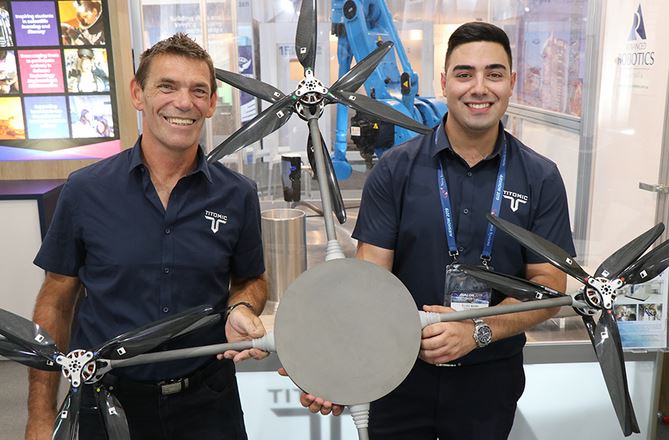
Melbourne based Australian startup developed Titomic Kinetic Fusion (Cold Spray of powder)) to produce load-bearing 3D forms from metallic and
non-metallic powder feedstock. The 2 co-inventors, Mr. Jeff Lang and
Professor Richard Fox, explored IP spraying metal powders at supersonic
speeds onto a scaffold to build a 3D object. This was found to be a
patentable application. The CSIRO patent was licensed and a new company,
Titomic, was established to commercialize this technology.
Why Titomic Kinetic Fusion
At least 5 times faster than fastest Metal AM method out there.
Fuse dissimilar metals for large seamless structures with enhanced engineered properti.
Stronger structures without welding, folding or bending weak points.
Production volumes without extensive production tooling.
Industry-leading build rates, faster manufacturing time & speed to market.
More efficient use of energy and resources, saving production costs.
Observations
As this is a cold-welding operation, it is to be seen that what is the smallest feature it can print.
Accuracy of manufactured parts.
Extensive post processing may require.
More accurate features may require machining.
Company is targeting large size parts specific to Aerospace applications where cost of Titanium is a concern. Big portion of the metal is lost when applying subtractive methods for manufacturing.
Tool manufacturer SANDVIK COROMANT showcased a Milling cutter body (Light Weight CoroMill 390) manufactured by additive.
Advantages:
Light Weight.
Shorter tool body length.
Better tool life.
Silent Tools™ damping technology offers high productivity when machining with long overhangs.
According to Sandvik "When designing lightweight CoroMill® 390, material has been
tactically removed to create the optimal cutter design for minimizing mass. This makes it more compact and significantly lighter than a conventional cutter"
Applications:
Lightweight CoroMill® 390 is designed for long reach face milling, deep shoulder and side milling, cavity milling and slot milling.
To be used at depths more than four times the cutter diameter combined with Silent Tools™ milling adaptor.
German RepRap LAM launched its production ready 3D printer. LAM is aiming to achieve injection molding like part quality.
Liquid
additive manufacturing (LAM) is an additive manufacturing process in
which liquids (or low-strength materials) can be additively processed,
such as liquid silicone rubber (LSR) or polyurethane (PU). In the
future, other liquids are conceivable. The technical characteristics of
the LAM printed objects and the injection molding process are almost
identical. Further advantages include high process speeds and
distortion-free 3D printing of any component.
For the first time i got a chance to check out HP's Multi Jet Fusion 3D printing technology at an event in Burnaby BC. Attendees got a chance to to listen to the experts from HP. We also got a chance to ask questions, look at the 4200 series machine and some of the printed parts.
The event was organized by HAWK RIDGE SYSTEMS. Hawk Ridge is reseller of HP 3D machines. They opened up an office in Richmond BC recently.
Some websites are classifying HP as SLS (Selective Laser Sintering) method, which is not correct.
Although MJF is one of the Bed-fusion methods but very different from SLS. I have written a blog about MJF and SLS processes in the past, please check out my previous blogs.
According to HP Team:
MJF Parts are superior in strength as compare to any other process e.g. SLS, FDM.
Prints are Watertight.
Printing speed is huge advantage as whole surface is cured in one single pass.
Printing cost is also very affordable. One full build cost roughly around $1000. The material cost around $200-300/kg depending on model of the machine.
Recently HP launched two models (HP 500/300) for prototyping, cost of the machine is around $60k according to the rep at the event. Production system is close to $200k. More accurate Quote can be achieved from the reseller in your area.
Thanks to voxel control on each slice you can achieve vivid colors and countless color schemes in your prints.
Other Consideration:
Noise level of the system is on the high side, You don't need earplugs but you don't want to sit next to it whole day.
Infrared spew quite a bit of heat, system should not be housed in a small room without any ventilation. Otherwise no special exhaust system needed for the machine.
Like all other powder based methods, MJF parts would need some sort of Bead-Blasting after printing.
Thanks to Hawk Ridge and HP team for putting together the event.
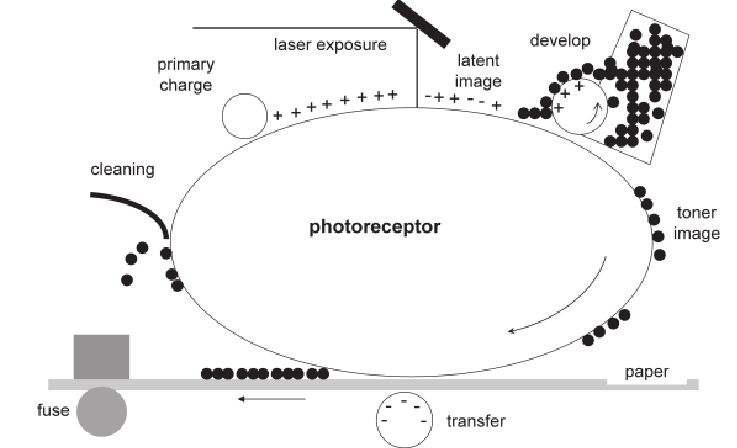
Stratasys is developing a new Bed Powder Fusion process at one of its subsidiary "Vulcan Laboratories Inc". The process is called "Selective Toner Electrophotographic" Main aim is to develop a process to address the need of high volume production of metal products.
Six Basic Steps of the Process
Charging.
Exposure.
Developing.
Transferring.
Cleaning.
Fusing.
“Our team will bring a unique perspective to solving many of the issues
from an end-user perspective,” comments David K. Leigh, CEO of Vulcan
Labs, Inc. “We’re looking forward to delivering new solutions for
customers to take control of their applications, while having the tools
in place to manage their own quality.”
Another variant of Metal Jetting combined with Polyjet in the works by Desktop-Metal. This is ultimate solution for high volume metal parts production as per DM. The method claimed to be 100 times faster and 20 times cheaper than current laser based systems in the market.
HP's Metal Jet Printing method is very similar to Single-pass jetting announced by Desktop Metal (DM) few months ago. Most of the new methods are targeting to address the printing speed as this is one big hurdle in progressing additive manufacturing to next level. Few variants of metal jetting methods have been announced during the span of last couple years, HP's Metal-Jet being the latest.
Focus is to offer more affordable solutions. These methods may not be able to print highly detailed parts but certainly offer more affordable solution for industry at large. Metal-jet methods have been serving tooling and fixturing needs in the industry very successfully.
Selective Laser Sintering (SLS) is one of the most popular technology when it comes to professional level Additive Manufacturing, Because of its capability of printing fine details and accurate parts. Material choices, low material cost and recycle ability of left over material are also apparent advantages.
Similarly Polyjet technology is also being used widely in the industrial level Additive manufacturing again because its own particular strengths.
High Speed Sintering Process
Professor Neil Hopkinson invented and patented new method by marrying these two methods called "High Speed Sintering". Here is how it works.
Layer of powder is spread as per slice thickness.
Infrared absorbable ink is spread only in the areas where slice will be built.
Bed is irradiated with infrared Lamp.
Ink absorbs the energy and melts the underlying particles.
Mr Neil who is now director of 3D Printing at Xaar is working on commercialization of the technology in collaboration with Voxeljet . Learn more about the technology at the link below. Xaar High Speed Sintering
The clip below shows how it works
The process when fully commercialized promised to bring speed and affordability to the high end Additive manufacturing. When it comes to use of additive in mass production, speed is one major hurdle and that is what some of the new processes are trying to improve on.
Voxeljet announced the commercialization of the technology
It is the most asked question. In my Rapid Prototyping class students usually gathers around me in the very first lesson and i am bombarded with the same question again and again. A lot of my visitors are curious about the prices of the machines. People from the industry want to get an unbiased review and would like to know which machine they should buy.
As 3D industry is multiplying day by day, big players are jumping in to grasp the marketplace and more focused technologies and brands are surfacing, A clear ONE answer to the question is not possible. When people ask me, my first response usually is a question "If you are an automotive expert and someone comes to you out of the blue and asks " I want to buy a car which one should i buy". Do you have a clear answer for this person. Obviously, you want to know a bit more about the needs of the person and why he/she want to buy a car before you can try to come up with a possible answer. And that applies here as well, One should have at least some idea why do you want to buy a 3D printer.
Well! for all my industrial and more professional friends it is a very crowded market for a lot of different users so i would recommend having a chat or meet in person and i would love to share my views and reviews. I can certainly help you in narrowing down the choices.
For my hobbyist friends, i would suggest watching the following video.
Few more considerations:
Generally closed console printers performs better than open concept.
Delta design might serve you better If you are in for bigger volume and not super conscious about the quality.
For those who are willing to spend a bit more and looking for professional machines like quality, I recommend Ultimaker.
BCN 3D has better design for those who are looking for Dual-Extrusion capability.
FormLabs is a great choice for Resin based category, best fit for smaller highly detailed parts.
Let me know if you have question. Comments are welcome.
References: RcLifeOn Youtube channel Ulimakers BCN 3D FormLabs
When it comes to FFF 3D printing, changing or adding of filament during the print is always challenging. The problem becomes more apparent when printing large size 3D models. Answer lies in pellet extrusion. Titan Robotics recently introduced 3D machine with Pellet Extrusion capability at Rapid + TCT 2018.
The loading of more pallets during the print is as easy as 123, just pour some more when ever it runs out. Auto re-loader can be attached to machine to keep it going unattended for ever, all these equipment are already available and being used for Injection and Blow molding machines.
If you remember about a year or so ago First 3D printed car was printed on CINCINNATI 3D machine over the weekend on one of Pallet Extrusion machines.
Competition in Inkjet segment about to get fierce as award winning KEYENCE Agilista 3000 enters the Polyjet or InkJet market of professional grade 3D printing machines. With more material choices and water soluble support material, it is going to give one heck of completion to the market leaders like Stratasys and 3D systems. Learn more about the technology here
The Japanese brand is entering the market to compete against well established Objet from Stratasys and Multijet from 3D-Systems.
Features:
High temperature Model material can resist up to 100 degree C.
Two relatively new players in the 3D world have announced similar Metal Printing concepts within last few months. Markforged announced the launch of MetalX in January and then Desktop Metal announced the launching of DM-Studio printer in May this year. Also Desktop-Metal announced the coloration with a North American 3D giant "Stratasys". Both Markforged and Stratasys are accepting orders for the systems to be shipped in near future.
Similarities
Powder metal is encapsulated in a binder, extruded on to a platform just like normal FDM method.
Some of the binder is washed at a washing station after printing.
After washing parts are sintered in a furnace.
Furnace sintering causes the part to shrink quite a bit, up to 20% depending on the metal. Shrinkage factor is calculated and added by the software at the time of process.
Markforged’s process is called Atomic Diffusion Additive Manufacturing (ADAM).
Desktop Metal has developed the Bound Metal Deposition (BDM) approach.
Both systems are expected to cost around $120k.
Metal X from Markforged
DM Studio from DeskTop Metal
Desktop Metal production system
Observations
Even though both brands are marketing their systems as suitable for office. Washing process involves chemicals and heat, causing fumes and vapors which need to be exhausted properly.
Both processes use furnace to sinter metal. The sintering process spew fumes and again need adequate exhaust.
Inconsistencies in shrinkage factor may cause less accurate parts when compare to other established technologies.
Print-ability of small features may be limited.
Printing resolution may be a concern for some users.
The systems are much more affordable as compare to metal laser sintering processes which can open up possibilities of serving cost conscious industries.
The process could be a good fit for additive + subtrative combination. Complex shapes can be printed and accurate features can be CNC machined.
Hewlett-Packard (HP) is a well known brand in manufacturing of printing machines for decades. It has been in the news for some time that HP is working on building its own line of 3D printing machines. Obviously when a big player like HP coming to the market place to compete, they don't want to be one from the crowd rather they want to bring a fresh idea to address certain need of the market.
After much anticipation HP showcased "HP Multi Jet Fusion" machine at Formnext 2016.
Most of the new technologies are fusion of some of the existing ones. "Multi Jet Fusion" is part "Powder Based" machines Z-Corp has been building for some time and part "Selective Laser Sinteing" SLS technology, obviously with its own advanced ingredients. HP is in to compete with top of line professional and production brands.
Strengths:
Better Quality: Comparing to most FDM machine
Higher Speed: In comparison wit FDM and SLS machines
Cost effective: Better recycling ability of powder materials, almost to 80%.
Technical Specs:
Dimensional accuracy of ±0.2 mm/0.008 inches
Layer thickness 0.1mm/0.004 inches
Solutions for Each Segment of the Industry:
The HP Jet Fusion 3D 3200 Printer is ideal for prototyping, offering
improved productivity and the capacity to grow usage at a lower cost
per part.
The HP Jet Fusion 3D 4200 Printer is designed for prototyping and
short-run manufacturing needs, with high productivity to meet same
business day demands at the lowest cost per part.
According to HP "The new solutions will be sold in the U.S. and Canada, as well as
select European countries. Availability will be expanded to include
additional European and Asian markets in the second half of 2017.
Delivery of the HP Jet Fusion 3D 4200 Printer will come in late 2016.
Delivery of the HP Jet Fusion 3D 3200 Printer will come in 2017".
The HP Jet Fusion 3D 3200 Printer starts at $130,000, and the full
end-to-end solution (HP Jet Fusion 3D 3200 Printer and Processing
Station) is available starting at $155,000.
If we look at the Quality, Resolution and Layer thickness of the machine, lot of professional grade FDM machines are in the same range. Price is also not hugely different. One front where it is better for sure is the speed. Choice of materials and color schemes are another big plus for HP.
On the other hand if we compare it with some of the SLS brands out there. SLS machines are more accurate and can deliver better resolution and layer thickness. SLS machines are mostly higher in price and slower in speed in comparison with HP.
Overall HP machines could be great bang for the buck for certain segments of the industry if they will be able to deliver the promises with out any hiccups. HP realizes the completion is tough, listen to the tone at the NewYork show in the clip below.
Eco concrete ideas in collaboration with HighCon have developed a new technology that allows you to create previously unfeasible items in concrete. 3PM (3D Printed Mold) is a technology that converts a 3D design file into a proprietary software that is then used to create multilayered paper molds.
Each paper slice is printed separately and then aligned and assembled to create a mold. Concrete is poured in to the mold. Paper mold will be broken away after curing of concrete.
Electron Beam Melting (EBM)
Although it is quite different but it seems like advanced form of Direct Metal Laser Sintering (DMLS).The Arcam EBM machines utilize
a high power electron beam that generates the energy needed for high
melting capacity and high productivity. The electron beam is managed by
electromagnetic coils providing extremely fast and accurate beam control
that allows several melt pools to be maintained simultaneously
The Arcam EBM process takes
place in vacuum and at high temperature, resulting in stress relieved
components with material properties better than cast and comparable to
wrought material.
Learn more about EBM here
MagnetoJet
Father and son company has come a long way to develop Magnetojet. They are ready to launch their very first production machine. Vader machines will be available for purchase soon.
Vader’s patent pending MagnetoJet technology is based on the study of
Magneto Hydro Dynamics (MHD), or more simply: the manipulation of liquid
metal through magnetism. MagnetoJet’s extraordinary physics are
accomplished by depositing Aluminum wire into an 800°C ceramic chamber,
where it is influenced into a molten state. This molten media is then
electromagnetically pulsed – causing a droplet to form and eject with
precision from a carefully crafted ceramic nozzle.
GDP is a new technology developed by Msssivit. GDP is combining FDM way of deposition of Gel with Polyjet way of curing the gel like material with high power UV light. The major advancement is the printing speed. The brand is focused on Speed and Big size prints. Target industry is advertisement and displays.
GDP is unique to Massivit 3D. There is no other 3D printing company
utilizing this technology. Massivit 3D technology was structured to fit
the specific needs of printing large objects – that is what makes it
unique. At the heart of the GDP process is Massivit’s unique printing
gel & smart support.
Massivit 3D solution is very fast, and capable of printing up to 35cm / 1ft per hour. As an example it would take ONLY 5 hours to print a simple sculpture of a standing human being in full size.
 6ftx20in stainless steel propeller blade weighing 170lbs. The blade features a hollow interior with .25in sidewall and is made with little porosity or impurities due to closed loop senor system developed by MWES.
 Fully stainless steel airplane. Weighing in at approximately 100 lbs. and 48in long, the plane body was made in Stainless Steel while the wings and tails in super duplex stainless steel. Total project printing time was 20 hours.