Wednesday, 8 May 2019

Push for Large Size Metal AM Parts

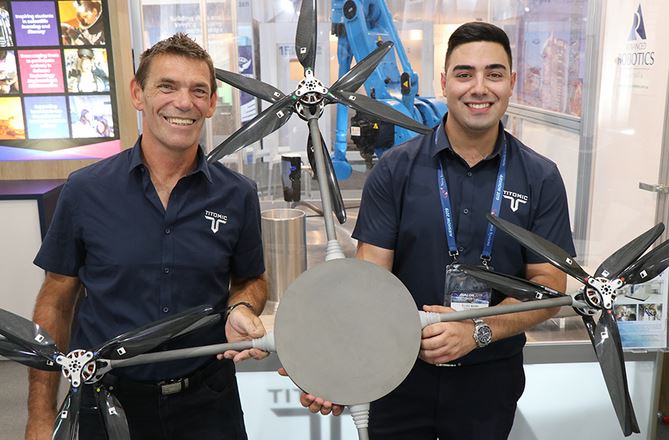
Melbourne based Australian startup developed Titomic Kinetic Fusion (Cold Spray of powder)) to produce load-bearing 3D forms from metallic and non-metallic powder feedstock. The 2 co-inventors, Mr. Jeff Lang and Professor Richard Fox, explored IP spraying metal powders at supersonic speeds onto a scaffold to build a 3D object. This was found to be a patentable application. The CSIRO patent was licensed and a new company, Titomic, was established to commercialize this technology.


Why Titomic Kinetic Fusion

  • At least 5 times faster than fastest Metal AM method out there.
  • Fuse dissimilar metals for large seamless structures with enhanced engineered properti.
  • Stronger structures without welding, folding or bending weak points.
  • Production volumes without extensive production tooling.
  • Industry-leading build rates, faster manufacturing time & speed to market.
  • More efficient use of energy and resources, saving production costs. 

  Observations

  • As this is a cold-welding operation, it is to be seen that what is the smallest feature it can print.
  • Accuracy of manufactured parts.
  • Extensive post processing may require.
  • More accurate features may require machining.
  • Company is targeting large size parts specific to Aerospace applications where cost of Titanium is a concern. Big portion of the metal is lost when applying subtractive methods for manufacturing.  

 Want to learn more about TKF, please read here

References:
Titomic.com

Thursday, 2 May 2019

Additive Helping Subtractive

Milling Tool Body Manufactured by Additive 

Tool manufacturer SANDVIK COROMANT showcased a Milling cutter body (Light Weight CoroMill 390) manufactured by additive.

Advantages:

  • Light Weight.
  • Shorter tool body length.
  • Better tool life.
  • Silent Tools™ damping technology offers high productivity
    when machining with long overhangs. 
According to Sandvik "When designing lightweight CoroMill® 390, material has been
tactically removed to create the optimal cutter design for minimizing mass. This makes it more compact and significantly lighter than a conventional cutter"

Applications:

  • Lightweight CoroMill® 390 is designed for long reach face milling, deep shoulder and side milling, cavity milling and slot milling.
  • To be used at depths more than four times the cutter diameter combined with Silent Tools™ milling adaptor.


References:

Sandvik Coromant

Tuesday, 6 November 2018

Liquid Additive Manufacturing (LAM)

German RepRap LAM launched its production ready 3D printer. LAM is aiming to achieve injection molding like part quality.


Liquid additive manufacturing (LAM) is an additive manufacturing process in which liquids (or low-strength materials) can be additively processed, such as liquid silicone rubber (LSR) or polyurethane (PU). In the future, other liquids are conceivable. The technical characteristics of the LAM printed objects and the injection molding process are almost identical. Further advantages include high process speeds and distortion-free 3D printing of any component.

L280 Model Shown here 

Specifications:

References:
Germanreprap.com

Friday, 2 November 2018

HP Showcased MJF Technologhy in Vancouver


For the first time i got a chance to check out HP's Multi Jet Fusion 3D printing technology at an event in Burnaby BC. Attendees got a chance to to listen to the experts from HP. We also got a chance to ask questions, look at the 4200 series machine and some of the printed parts.


The event was organized by HAWK RIDGE SYSTEMS. Hawk Ridge is reseller of HP 3D machines. They opened up an office in Richmond BC recently.


Some websites are classifying HP as SLS (Selective Laser Sintering) method, which is not correct.
Although MJF is one of the Bed-fusion methods but very different from SLS. I have written a blog about MJF and SLS processes in the past, please check out my previous blogs.


According to HP Team:

  • MJF Parts are superior in strength as compare to any other process e.g. SLS, FDM.
  • Prints are Watertight.
  • Printing speed is huge advantage as whole surface is cured in one single pass.
  • Printing cost is also very affordable. One full build cost roughly around $1000. The material cost around $200-300/kg depending on model of the machine.
  • Recently HP launched two models (HP 500/300) for prototyping, cost of the machine is around $60k according to the rep at the event. Production system is close to $200k. More accurate Quote can be achieved from the reseller in your area.
  • Thanks to voxel control on each slice you can achieve vivid colors and countless color schemes in your prints.    

Other Consideration:

  • Noise level of the system is on the high side, You don't need earplugs but you don't want to sit next to it whole day.
  • Infrared spew quite a bit of heat, system should not be housed in a small room without any ventilation. Otherwise no special exhaust system needed for the machine.
  • Like all other powder based methods, MJF parts would need some sort of Bead-Blasting after printing.
Thanks to Hawk Ridge and HP team for putting together the event.

Wednesday, 31 October 2018

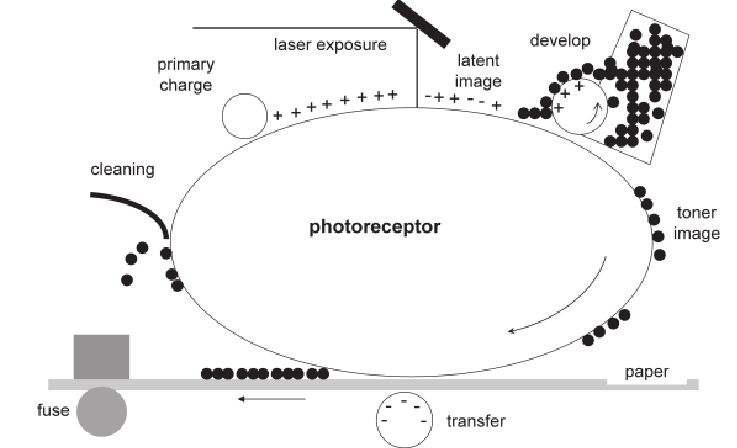
Selective Toner Electrophotographic Process

Stratasys is developing a new Bed Powder Fusion process at one of its subsidiary "Vulcan Laboratories Inc". The process is called "Selective Toner Electrophotographic" Main aim is to develop a process to address the need of high volume production of metal products.

Six Basic Steps of the Process

  1. Charging.
  2. Exposure.
  3. Developing.
  4. Transferring.
  5. Cleaning. 
  6. Fusing.

“Our team will bring a unique perspective to solving many of the issues from an end-user perspective,” comments David K. Leigh, CEO of Vulcan Labs, Inc. “We’re looking forward to delivering new solutions for customers to take control of their applications, while having the tools in place to manage their own quality.”
References:
Stratasys.
Research Gate.


Friday, 21 September 2018

Single Pass Jetting

From Desktop Metal

Another variant of Metal Jetting combined with Polyjet in the works by Desktop-Metal. This is ultimate solution for high volume metal parts production as per DM. The method claimed to be 100 times faster and 20 times cheaper than current laser based systems in the market.

 
References:
DesktopMetals.com

Thursday, 20 September 2018

HP Launches Metal Jet Printing

HP's Metal Jet Printing method is very similar to Single-pass jetting announced by Desktop Metal (DM) few months ago. Most of the new methods are targeting to address the printing speed as this is one big hurdle in progressing additive manufacturing to next level. Few variants of metal jetting methods have been announced during the span of last couple years, HP's Metal-Jet being the latest.
Focus is to offer more affordable solutions. These methods may not be able to print highly detailed parts but certainly offer more affordable solution for industry at large. Metal-jet methods have been serving tooling and fixturing needs in the industry very successfully.


References:
HP